Ask what and where without moving the question word to the front
A Mandarin information question often keeps the question word where the answer would belong. This makes a useful beginner strategy: build a statement, identify the missing information, and replace that piece. Learn the contrast between asking an action’s object and asking its location.
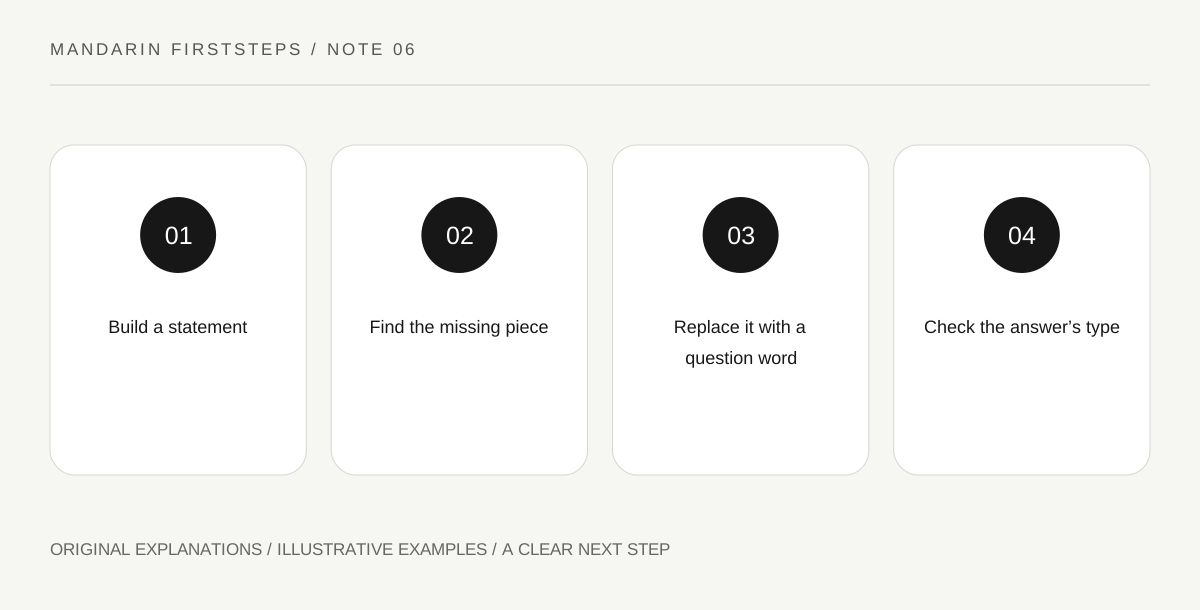
Original explanatory diagram. Read the full method and limitations below.
Replace the thing after the verb
Wǒ hē chá, 我喝茶, means I drink tea. To ask what you drink, use Nǐ hē shénme, 你喝什么. Shénme, 什么, occupies the place where chá would appear in an answer. English moves what to the front, but copying that movement produces an unhelpful beginner Mandarin pattern.
Write a statement with a blank after its verb. Fill the blank with chá, water or another familiar drink. Then replace the whole missing item with shénme. Say the question aloud and answer it with a short phrase. A genuine question should leave the answer open rather than imply the learner must choose the word shown in the lesson.
Ask about destination or location
Nǐ qù nǎr, 你去哪儿, asks where you are going. Nǐ zài nǎr, 你在哪儿, asks where you are. Nǎr and nǎlǐ are common where forms with regional preferences. They are useful to recognize together, but beginners can choose one consistent spoken form while learning the pattern.
The verb matters. Going to a place and being at a place are different meanings. Put two pictures on a table: a person moving toward a library and a person already inside it. Match each picture to the relevant question. This small contrast prevents where from becoming a single memorized question whose purpose changes unpredictably.
Do not add ma to every question
Ma, 吗, helps form many yes-or-no questions, but an ordinary shénme or nǎr information question does not also need it. Nǐ hē chá ma asks whether you drink tea. Nǐ hē shénme asks what you drink. These questions request different kinds of answers even though the topic is similar.
Practise sorting questions into two groups: a choice between yes and no, or a missing piece of information. Then answer them appropriately. For the first, repeat the relevant verb positively or negatively as you learn the reply pattern. For the second, supply the drink, place or other requested content.
Keep enough of the answer to be clear
A short answer such as chá may be sufficient in context, while Wǒ hē chá rehearses the complete pattern. Both serve learning purposes. Use full sentences for a controlled exercise and allow shorter replies in a realistic role-play. Do not mistake a classroom drill requirement for the only acceptable way to speak.
Create four information-gap cards with different destinations and drinks. A partner cannot see your card and must ask a question to complete a chart. After the exchange, compare charts. This gives the grammar a job: finding out information the listener genuinely lacks. An incorrect chart reveals whether the problem was the question, vocabulary or listening.
Illustrative missing information
Sam’s card says that Sam drinks water and goes to the library. Lin asks Nǐ hē shénme? Sam answers Wǒ hē shuǐ, 我喝水. Lin then asks Nǐ qù nǎr? Sam answers Wǒ qù túshūguǎn, 我去图书馆. Lin records water and library. Asking Nǐ hē shuǐ ma would have tested one guess instead of requesting the missing item.
Practical checks
Optional checkboxes save only in this browser.
Questions that come up
Are nǎr and nǎlǐ interchangeable in every sentence?
They often serve the same where function in beginner exchanges, with regional and stylistic differences. Learn the form used by your teacher and listen for the other, rather than treating one as an error.
Do all Mandarin questions keep the normal word order?
Many beginner question-word patterns do, but Mandarin has multiple question structures. This replacement method applies to the examples here; it is a starting point rather than a complete account of every question construction.
References and scope
These sources support the factual background. Examples and exercises are original illustrative teaching material. References do not imply endorsement.
- Open University: Getting started with Chinese 2 — Everyday activities, sentence order, time expressions, questions and choices.
- Open University: Asking questions with what and where — Question words in their corresponding statement positions.