Use Mandarin numbers for quantities, prices and phone digits
Counting to ten is the beginning of number use. Real exchanges require you to distinguish a quantity from a sequence of digits, hear similar-sounding numbers, and confirm the whole amount. Practise those jobs separately before combining them in shopping or appointment conversations.
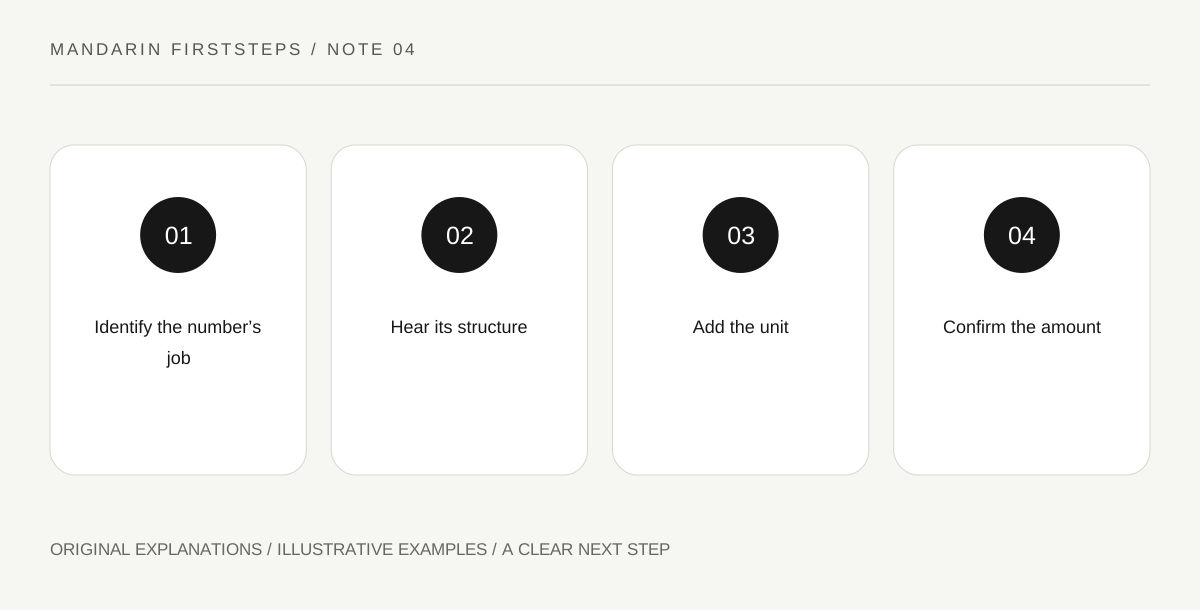
Original explanatory diagram. Read the full method and limitations below.
Build two-digit numbers from their structure
Learn líng, yī, èr, sān, sì, wǔ, liù, qī, bā and jiǔ for zero through nine, then shí for ten. Eleven is shíyī; twenty is èrshí; twenty-three is èrshísān. This regularity helps you construct an unfamiliar number, but construction on paper is easier than recognizing a number spoken quickly.
Make a mixed set such as 14, 40, 19 and 90. Say a number, write the digits, and check. Focus on the distinction between shísì, fourteen, and sìshí, forty. Their order changes the value. Use a recording or partner to vary the sequence, so memory of the list does not substitute for listening.
Separate a digit string from a quantity
Phone numbers and room codes are normally read as individual digits rather than as one enormous quantity. The digit one is often pronounced yāo in telephone contexts to reduce ambiguity, although yī is also the ordinary number word. Learn to recognize both and ask for a repeat when a digit is uncertain.
Use invented short codes for practice instead of publishing real contact information. Read 5081 digit by digit, then ask your partner to repeat the digits back. The feedback should identify a position, such as the third digit, rather than force a complete restart every time. This mirrors the practical problem of correcting one missed part.
Learn the role of liǎng
Mandarin commonly uses liǎng for two before many measure words, as in liǎng gè rén, 两个人, two people, and liǎng bēi chá, 两杯茶, two cups of tea. The digit two in a phone number is èr, and twenty is èrshí. These are different uses rather than an arbitrary choice between interchangeable words.
Start with a small phrase group: two people, two cups, number two, and twenty. Say them in random order. You do not need to master every large-number exception immediately. A beginner benefits from reliable common chunks and a note that the rule has a wider grammar beyond the first examples.
Confirm units with the amount
A bare number can be misunderstood even when the digits are correct. Prices need currency context; meeting times need part of day; quantities need an item or container. Repeat enough information to show what you understood. At a counter, pointing to a displayed price and confirming the total can be more reliable than guessing from one syllable.
For a practical exercise, give a partner three cards: a quantity, a price and a code. They read one without announcing its type. Your task is to ask the missing contextual question and record the answer. This develops a useful habit: understanding what a number refers to before acting on it.
Illustrative café number check
A learner wants two cups of tea and says Liǎng bēi chá. The seller gives an illustrative total of èrshísì, twenty-four. The learner repeats Èrshísì, duì ma, twenty-four, right, while looking at the displayed total. Later, a pickup code of 204 is read digit by digit. The same number words now serve three different jobs.
Practical checks
Optional checkboxes save only in this browser.
Questions that come up
Can I always replace èr with liǎng?
No. Use èr for the digit two and in numbers such as twenty; learn liǎng with common measure-word phrases. Larger-number usage has additional patterns, so check a reference when moving beyond these beginner cases.
Should I rely on finger gestures?
Gestures can help but vary and may be unfamiliar to either person. Combine spoken numbers with written digits or a displayed amount when accuracy matters, and confirm the meaning of the number as well as its shape.
References and scope
These sources support the factual background. Examples and exercises are original illustrative teaching material. References do not imply endorsement.
- Open University: Getting started with Chinese 1 — Beginner greetings, pronouns, pinyin, tones and numbers.
- Open University: Beginners’ Chinese taster course — Scripts, word formation, introductions, nationalities and telephone numbers.