Put time before the action in a Mandarin daily plan
English often places time at the end of a sentence. A dependable beginner Mandarin pattern places it before the verb. With a few activity phrases and clear time blocks, you can describe a simple day and understand when someone else intends to do something.
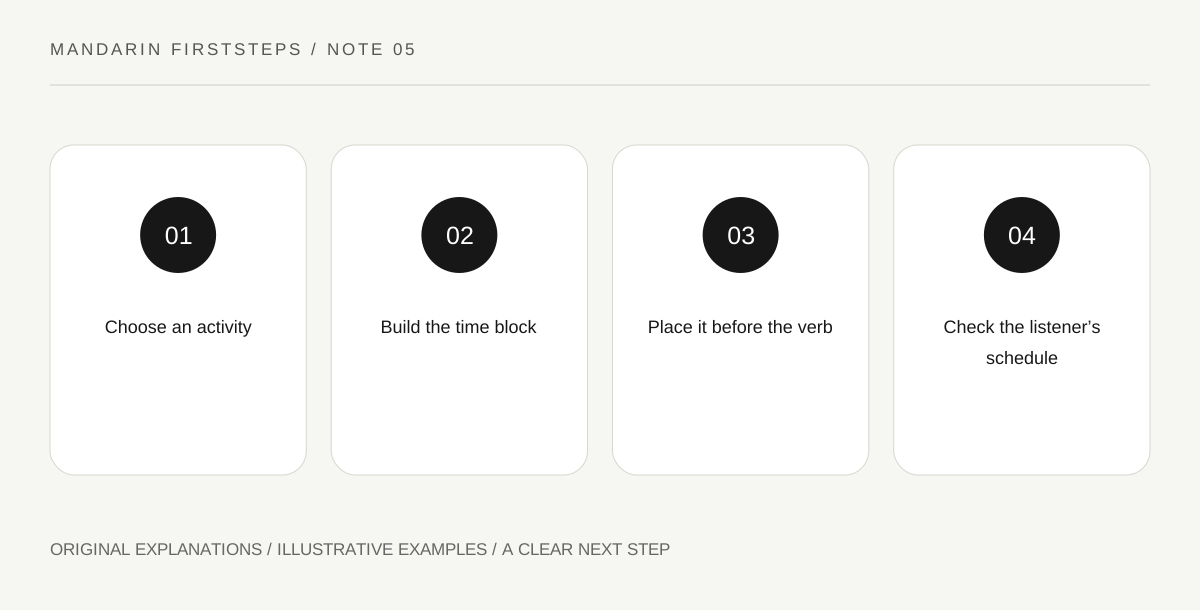
Original explanatory diagram. Read the full method and limitations below.
Start with a person and an action
Wǒ xué Zhōngwén, 我学中文, means I study Chinese. Wǒ kàn shū, 我看书, means I read books. These short sentences provide a stable base. Keep the verb and its object together while learning the action as a unit; repeatedly translating each syllable makes it harder to maintain a natural sentence order.
Use three actions that are true for you, such as studying, reading and drinking tea. Draw a small picture for each and say the phrase without text. Once you can retrieve the action, add a time. Trying to learn the vocabulary and the sentence pattern simultaneously can make a simple order problem feel much larger.
Insert a time block before the verb
Wǒ jīntiān xué Zhōngwén, 我今天学中文, means I study Chinese today. Jīntiān wǒ xué Zhōngwén is also a useful arrangement. For this beginner pattern, keep the time before the action rather than copying English word order and putting today at the end. The time may precede or follow the subject.
Build the sentence with movable cards labelled person, time and action. Read person–time–action, then time–person–action. Notice that the meaning remains similar. Do not turn this into a claim that all Mandarin time expressions always behave identically; duration and other constructions need separate study later.
Order a broad time before a narrower one
A phrase such as míngtiān wǎnshang, 明天晚上, tomorrow evening, goes from day to part of day. Wǒ míngtiān wǎnshang kàn shū describes reading tomorrow evening. For a weekly routine, xīngqīyī zǎoshang means Monday morning. Learn the time block as a coherent phrase so its internal order becomes familiar.
Make three schedule cards with different combinations: today afternoon, tomorrow morning and Monday evening. Ask a partner to point to the correct card after hearing your sentence. Change only the time on the second round. This makes the listener attend to the scheduling information rather than guess from a different action each time.
Distinguish plans from complete tense explanations
Mandarin verbs do not take English-style tense endings. Time words can locate an action in a beginner sentence, but that does not mean every past, current or future meaning is expressed by adding a date. Aspect, context and other expressions become important as you progress. At this stage, use the pattern for clear routine or planned activities.
Finish with a tiny listening task. Have a partner say two sentences about the same person on different days. Write the day, part of day and activity in three columns. If one field is missing, ask specifically about it. A schedule is understood when those pieces fit together, not when every sentence has been translated word for word.
Illustrative three-line plan
For practice, Mei writes Wǒ jīntiān wǎnshang xué Zhōngwén, I study Chinese this evening; Wǒ míngtiān zǎoshang kàn shū, I read tomorrow morning; and Xīngqīyī wǒ hē chá, I drink tea on Monday. A partner changes the second sentence to tomorrow evening. Mei updates the time column and leaves the action unchanged.
Practical checks
Optional checkboxes save only in this browser.
Questions that come up
Can the sentence begin with the time?
Yes. For these simple sentences, a time phrase can come before the subject or between subject and verb. Practise both arrangements while keeping the time ahead of the action.
Does a time word make a Mandarin sentence past tense?
It helps locate the event, but Mandarin does not form tense by adding English-like verb endings. Broader descriptions of completed actions and ongoing situations require additional patterns beyond this introductory schedule exercise.
References and scope
These sources support the factual background. Examples and exercises are original illustrative teaching material. References do not imply endorsement.
- Open University: Getting started with Chinese 2 — Everyday activities, sentence order, time expressions, questions and choices.
- Open University: Time expressions — Placing time expressions before the verb in beginner sentences.
- MIT OpenCourseWare: Chinese I, Fall 2014 — Integrated pronunciation, basic characters and practical everyday conversation; communicative practice.