Offer two clear choices with háishì
A choice question can be easier to understand than an open question, especially when the alternatives are visible. Mandarin uses háishì in common questions such as tea or coffee. Practise balanced alternatives, useful answers, and the difference between offering a choice and describing possibilities.
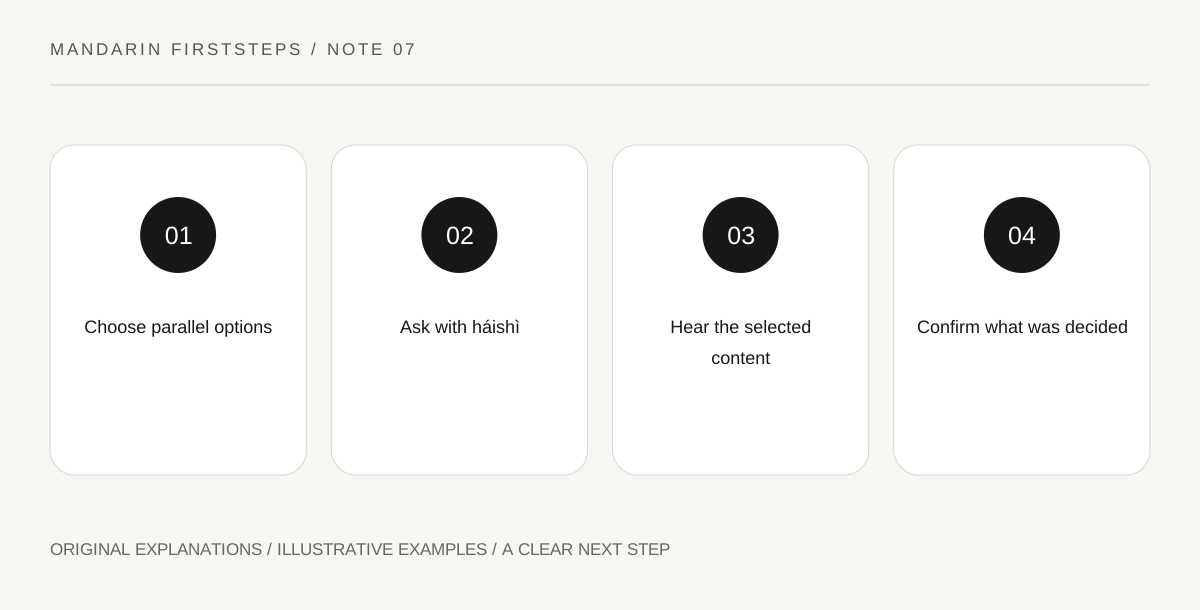
Original explanatory diagram. Read the full method and limitations below.
Keep the alternatives parallel
Nǐ hē chá háishì kāfēi, 你喝茶还是咖啡, asks whether you will have tea or coffee. The alternatives are both drinks and occupy the same role after the verb. This makes the structure easy to hear. You can point to the two items when practising, then gradually remove the visual support.
Start with alternatives that differ in one clear element: tea or coffee, today or tomorrow, morning or evening. Avoid giving a complete long sentence as the first option and an unexplained single word as the second. Parallel options reduce the amount the listener has to remember while deciding what was asked.
Hear the whole question before answering
Beginners sometimes answer as soon as they recognize chá, missing the second option. Wait for the speaker to finish. Listen for háishì as a signal that another alternative follows. In a controlled exercise, your partner can read the same first option with three different second options, requiring you to identify the full pair.
Do not assume the first choice is a recommendation. A person may list the options in any ordinary order. If one word is unfamiliar, ask for it again or point to the available objects. The goal is to choose based on understood alternatives, not reward the fastest answer.
Answer with the chosen content
You can reply Wǒ hē chá, I will have tea, or simply chá in a clear context. A bare yes does not identify which drink you want. If neither is suitable, say what you do want using a pattern you know, such as Wǒ xiǎng hē shuǐ, 我想喝水, I would like water.
An offered pair is not always exhaustive. In real interaction you can ask about another option, decline politely or explain a relevant need. For beginner practice, include a third card marked neither. This prevents the exercise from teaching that social politeness requires accepting one of two unwanted choices.
Separate question or from statement or
Háishì is used in these choice questions. Huòzhě, 或者, commonly links alternatives in statements, such as describing possible plans. The English word or maps onto more than one Mandarin pattern, so learn an entire example for each purpose. Do not replace every English or with one memorized Chinese word.
Make a mini café with a two-item menu and a planning desk with two possible days. Ask each partner one genuine choice question and record the answer. Then describe what was selected in a statement. Review whether your question offered a clear pair and whether the response actually resolved the choice.
Illustrative invitation choice
A learner wants to arrange a short study meeting. They ask Nǐ jīntiān lái háishì míngtiān lái, 你今天来还是明天来, are you coming today or tomorrow? The partner answers Míngtiān, then adds an afternoon preference. The learner repeats the selected day. The pair settles the day before negotiating the hour, keeping each question manageable.
Practical checks
Optional checkboxes save only in this browser.
Questions that come up
Should I add ma at the end of a háishì question?
An ordinary alternative question with háishì does not need ma. Practise the complete choice pattern as presented rather than attaching the yes-or-no particle to every sentence that asks something.
Can I use a short answer?
Yes, when the context makes the chosen option clear. Full-sentence replies are useful in practice, but a concise answer is often natural. Repeat more information when a date, amount or destination could be confused.
References and scope
These sources support the factual background. Examples and exercises are original illustrative teaching material. References do not imply endorsement.
- Open University: Getting started with Chinese 2 — Everyday activities, sentence order, time expressions, questions and choices.
- Open University: Choice questions — Asking alternatives with haishi.