Confirm a transport destination before discussing the journey
In transport conversations, an almost-correct place name can send you somewhere unintended. Put the destination first, support it with written information, and separate route questions from payment or timing questions. Beginner Mandarin is useful for checking details when combined with signs and official travel information.
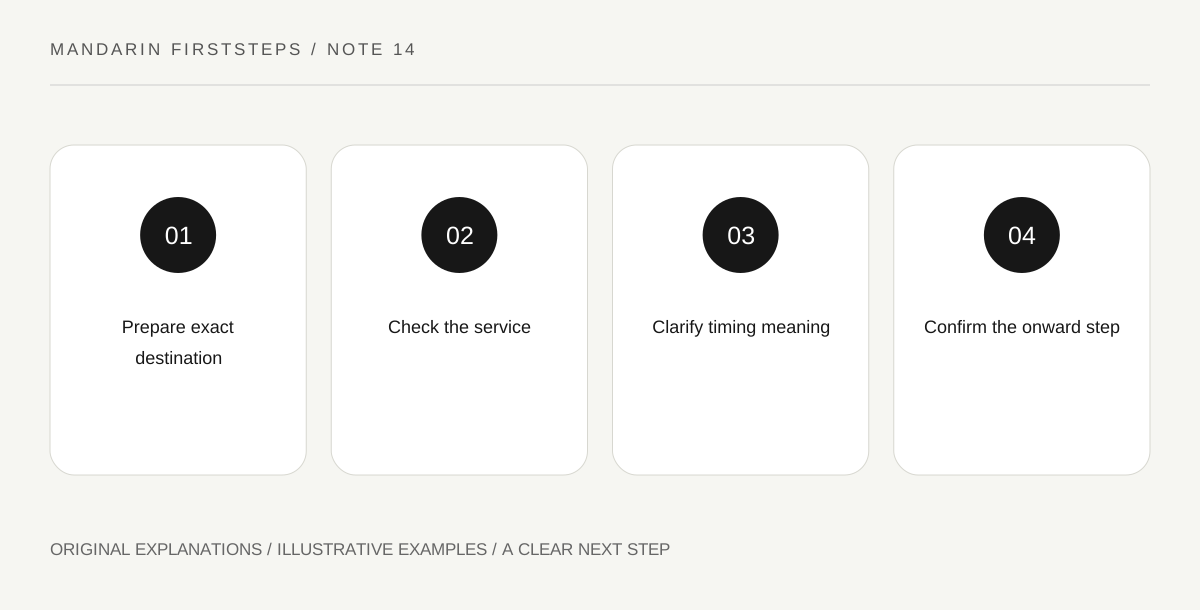
Original explanatory diagram. Read the full method and limitations below.
Prepare the exact destination
Wǒ yào qù…, 我要去…, means I want to go to…. Follow it with a place name you have checked. A hotel’s translated English name may not match its local sign, and several branches may share a brand. Keep the Chinese name, address and relevant map location together so they refer to the same place.
For practice, invent two branches of a café with distinct street names. Give the passenger a card showing one branch and the driver or staff member a card showing both. The listener must identify the exact branch rather than accept a familiar brand word as sufficient confirmation.
Ask whether the service goes there
A simple question such as Dào…ma, 到…吗, can ask whether a service reaches a named destination in context. Learn the whole exchange with a teacher or recording so it is not an unexplained fragment. On scheduled transport, compare the answer with the route display and posted destination.
A stop, station complex and specific exit are different levels of information. You may reach the correct station and still need an exit or onward walk. Keep the first question narrow: does this service reach the intended stop? Then resolve the next part. Several short checks are easier than one overloaded question.
Keep journey time separate from departure time
A number might describe minutes until departure, journey duration or the clock time of arrival. These meanings need context. Beginners should not infer the whole answer from recognizing one numeral. Point to the relevant part of a timetable or ask a focused follow-up to establish what the number measures.
Use three labelled boxes in a role-play: leaves at, takes, and arrives at. Put an illustrative number in each box and ask the learner to record the answer under the correct label. This tests comprehension of the transport information rather than only recognition of time vocabulary.
Finish with a shared destination record
Before relying on a conversation, check that the destination, direction of travel and relevant ticket or booking match. Rules, fares and services change, so use current operator information for actual travel. This lesson teaches language patterns and verification habits, not live transport advice or a replacement for local staff.
A practical rehearsal ends when both partners point to the same destination on the same map and agree what the next step is. If either person remains unsure, the correct outcome is clarification. Avoid treating a confident tone or a polite nod as evidence that a complicated place name has been understood.
Illustrative station exchange
A passenger wants the east entrance of a fictional City Museum. They show the Chinese destination card after saying Wǒ yào qù…. The staff member indicates a station serving the west side. The passenger points to east on the map, and the pair identifies an onward walk. The Mandarin request opened the exchange; the shared map resolved the more precise destination.
Practical checks
Optional checkboxes save only in this browser.
Questions that come up
Can I rely on a place name written in pinyin alone?
Pinyin can be ambiguous because different characters share pronunciations. Keep the Chinese name and a checked address or map pin as well. This is especially useful for businesses with multiple branches.
Does this lesson give current fares or routes?
No. Example journeys are illustrative. Consult the operator’s current information and signs for real travel, and use the language patterns to ask focused questions about details you need to confirm.
References and scope
These sources support the factual background. Examples and exercises are original illustrative teaching material. References do not imply endorsement.
- Open University: Getting started with Chinese 1 — Beginner greetings, pronouns, pinyin, tones and numbers.
- Open University: Asking questions with what and where — Question words in their corresponding statement positions.
- Open University: Beginners’ Chinese audio collection — Beginner conversation topics including directions, buying things, restaurant orders and invitations.