Tell the time and confirm an afternoon meeting
A clock time needs more than a number. Beginner Mandarin gives you a useful system for hours and minutes, but a practical meeting also needs the part of day and the correct reference point. Learn a few clear forms before adding conversational shortcuts.
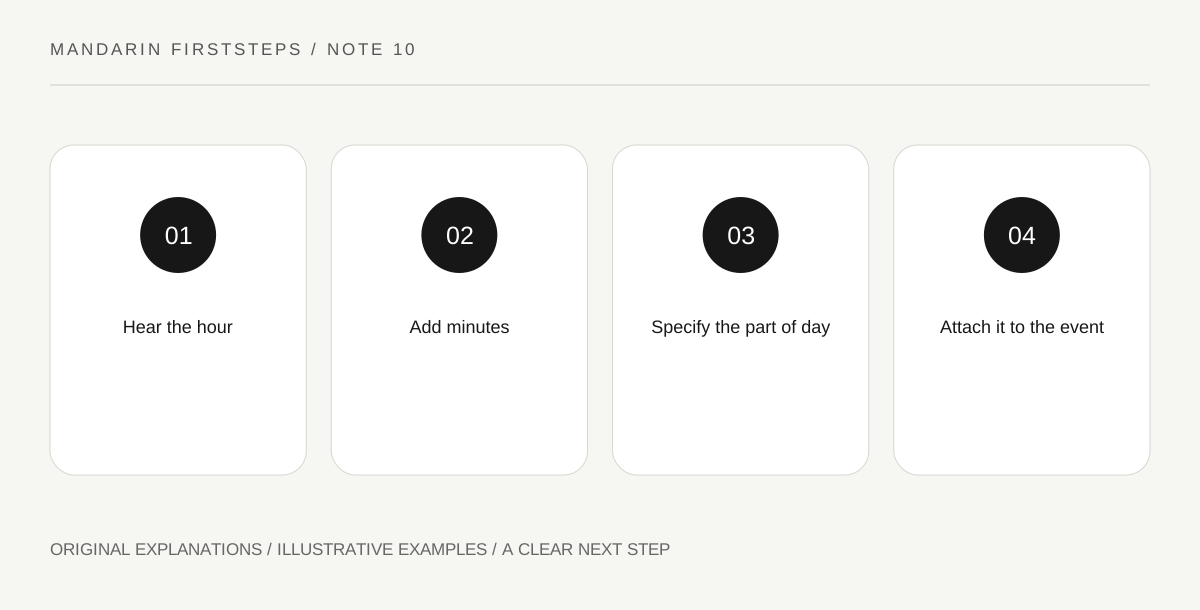
Original explanatory diagram. Read the full method and limitations below.
Use diǎn for the hour
Sān diǎn, 三点, means three o’clock. Jǐ diǎn, 几点, asks what time. In ordinary clock expressions, two o’clock is liǎng diǎn, 两点. Start by connecting a spoken hour to an analogue or digital clock. Saying the hours in numerical order is easier than hearing them out of sequence.
Put six clock faces on a page and number the pictures. Have a partner say one time and point to its picture. Then switch roles. If you confuse two and six, check the number words; if you understand the number but overlook the hour, practise the whole unit rather than adding new vocabulary.
Add minutes without guessing a missing zero
Sān diǎn shí fēn is three ten; sān diǎn líng wǔ fēn is three oh five. Fēn, 分, marks minutes. Bàn, 半, gives the common half-hour expression sān diǎn bàn, three thirty. Learn a transparent hour-and-minutes form first, then add other conventional expressions gradually.
Read 3:05, 3:15 and 3:50 as a mixed set. Write each in digits after hearing it. A zero in an early-minute time is useful information, not decoration. When accuracy matters, repeat the whole time rather than only the last number. Slow clarity is more valuable than demonstrating a sophisticated shortcut.
Specify the part of day
Xiàwǔ sān diǎn, 下午三点, means three in the afternoon. Zǎoshang, shàngwǔ and wǎnshang help distinguish morning, late morning and evening contexts. Their everyday boundaries are not mathematical definitions shared identically by everyone, so use the clear hour as well as the part-of-day word when arranging a meeting.
In a schedule sentence, keep the time before the action: Wǒmen xiàwǔ sān diǎn jiàn, 我们下午三点见, we meet at three in the afternoon. If the date is not established, add it separately. Three tomorrow and three next Monday are linguistically similar but practically different commitments.
Check what the time refers to
A departure time, arrival time and meeting time may all occur in the same exchange. Ask what event the number belongs to before making a plan. Similarly, a remote class may use the teacher’s time zone. A correctly heard hour can still produce a missed lesson if the two people assume different locations.
Make an exercise with a train departure, an expected arrival and a café meeting. Give each event a different illustrative time. Listen and fill the three labelled boxes. Then summarize the meeting with date, part of day and place. This turns number practice into the skill of attaching a time to the correct action.
Illustrative meeting correction
A partner proposes Xiàwǔ sān diǎn bàn, three thirty in the afternoon. The learner repeats Sān diǎn shí fēn, three ten. The partner corrects Bàn, then shows 15:30 on the practice schedule. They repeat the agreed time with the meeting place. The written confirmation resolves the difference without requiring a long explanation in unfamiliar Mandarin.
Practical checks
Optional checkboxes save only in this browser.
Questions that come up
Must I use half or quarter expressions?
No. A clear hour-and-minutes expression is a strong beginner choice. Learn common forms such as bàn as recognition vocabulary and add shortcuts only when you can hear and use them reliably.
Should I translate a 24-hour display into conversational time?
For a conversation you can use a part-of-day expression with an ordinary hour. For a ticket or written schedule, preserve the displayed time and confirm its meaning. Avoid silently changing an official record during language practice.
References and scope
These sources support the factual background. Examples and exercises are original illustrative teaching material. References do not imply endorsement.
- Open University: Getting started with Chinese 1 — Beginner greetings, pronouns, pinyin, tones and numbers.
- Open University: Getting started with Chinese 2 — Everyday activities, sentence order, time expressions, questions and choices.
- Open University: Time expressions — Placing time expressions before the verb in beginner sentences.