Introduce yourself with three short Mandarin sentences
A useful introduction does not require a biography. Learn to greet someone, give the name you actually use, and add one relevant fact. Then practise hearing the other person’s introduction so the exchange becomes a conversation instead of a memorized speech.
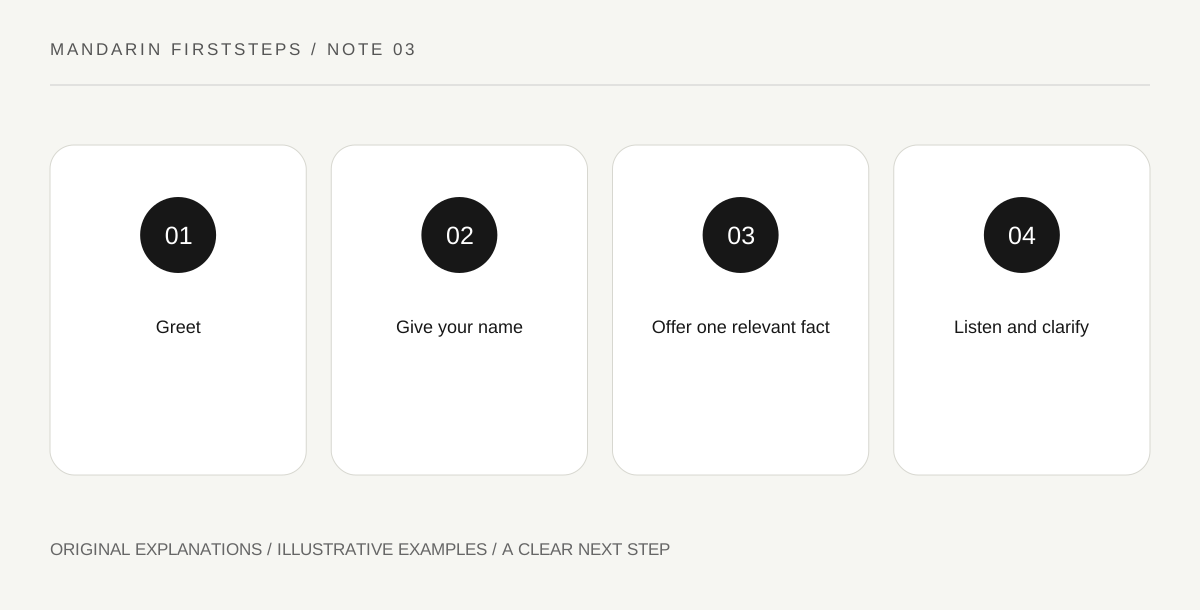
Original explanatory diagram. Read the full method and limitations below.
Choose a greeting for the setting
Nǐ hǎo, 你好, is a useful neutral greeting; nín hǎo, 您好, uses a respectful form of you. Actual greetings depend on familiarity, setting and regional habits, so neither phrase is a universal social formula. A beginner can start with a clear greeting and a friendly pause rather than searching for a highly formal expression.
Do not assume the textbook exchange Nǐ hǎo ma, how are you, is required whenever people meet. In many ordinary encounters a simple hello and the purpose of the conversation work well. Listen to how people in your learning environment greet each other, and distinguish a classroom practice pattern from a rule about all Chinese speakers.
Give your name without inventing one
Wǒ jiào…, 我叫…, means I am called… and provides a practical name introduction. Wǒ xìng…, 我姓…, gives a surname. A person can introduce themselves with their existing name; choosing a Chinese name is optional and benefits from knowledgeable help. Avoid presenting a machine-translated sequence as an established Chinese personal name.
Keep the name field as one chunk in practice. Say Nǐ hǎo, wǒ jiào Alex. Then pause and invite the other person to speak. If they ask Nǐ jiào shénme míngzi, 你叫什么名字, the question is about your name. You can answer with the short pattern you already know rather than copying every word of the question.
Add a fact that fits the encounter
A relevant fact might be Wǒ shì xuésheng, 我是学生, I am a student, or Wǒ xué Zhōngwén, 我学中文, I study Chinese. Notice that shì links a person to a noun identity, while xué is itself the verb study. Do not insert shì before every verb just because English introductions often contain am.
Nationality, occupation and place of residence are personal information, not obligatory introduction items. Choose what you are comfortable sharing. In a class, a learning goal may be more useful than a job title. In a brief service encounter, your reason for asking a question may matter more than where you come from.
Prepare to hear an unfamiliar name
Listening is the part that often breaks a rehearsed introduction. If you miss a name, say Qǐng zài shuō yí biàn, 请再说一遍, please say it again. You can ask someone to write it or show it on a screen when appropriate. Repeating a name respectfully is more useful than pretending you heard it.
Practise in pairs with different names and one changing fact. The listener repeats the fact in English to check understanding, then switches roles. On the next round, hide the script. A successful introduction is one in which both people can identify the other’s name and one offered detail, even if the delivery is slow.
Illustrative first class exchange
Alex says, Nǐ hǎo, wǒ jiào Alex. Wǒ xué Zhōngwén. The partner responds with a name Alex misses. Alex asks, Qǐng zài shuō yí biàn, and listens again. They end with Hěn gāoxìng rènshi nǐ, 很高兴认识你, nice to meet you. They have shared a name and a learning connection without turning the exchange into an interview.
Practical checks
Optional checkboxes save only in this browser.
Questions that come up
Do I need a Chinese name to introduce myself?
No. Use your own name clearly. If you later choose a Chinese name, ask a proficient speaker about meaning, pronunciation and how the full name sounds, rather than combining attractive dictionary characters without context.
Must I use nín with every older person?
Usage varies by community, relationship and occasion. It is a respectful pronoun that can be useful, but learning from local interaction and a teacher is better than applying an age-only rule mechanically.
References and scope
These sources support the factual background. Examples and exercises are original illustrative teaching material. References do not imply endorsement.
- Open University: Getting started with Chinese 1 — Beginner greetings, pronouns, pinyin, tones and numbers.
- Open University: Beginners’ Chinese taster course — Scripts, word formation, introductions, nationalities and telephone numbers.