Read a simple Mandarin date and choose the right weekday
Dates become easier when you keep their parts in a consistent order and avoid translating an English date one word at a time. Learn year, month and day as a sequence, then connect a written date to the weekday and the appointment you intend to make.
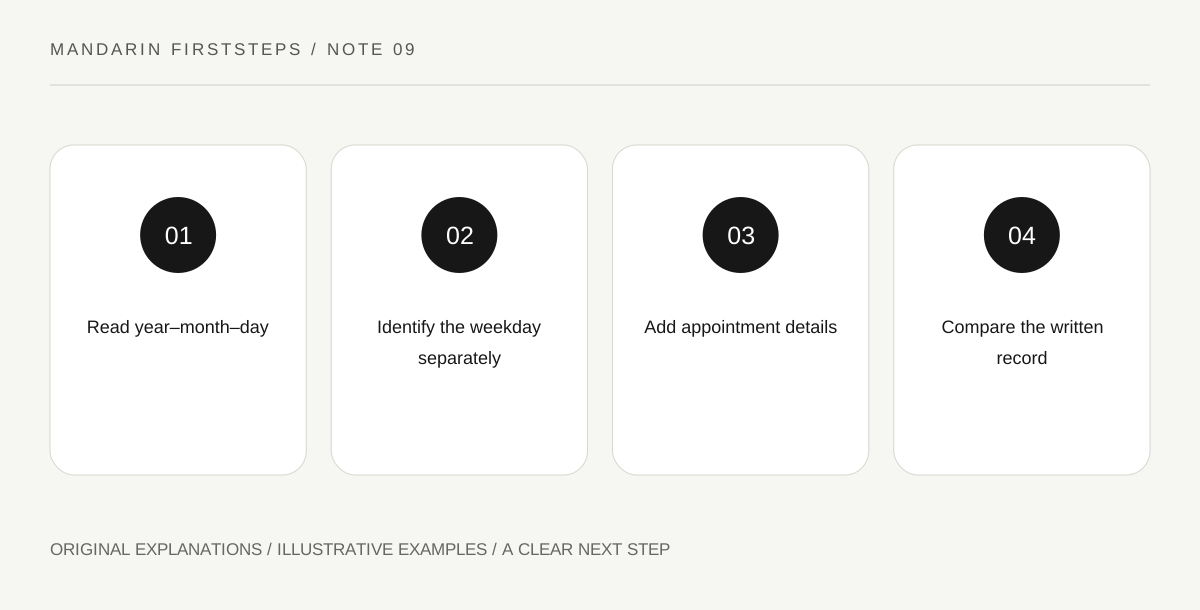
Original explanatory diagram. Read the full method and limitations below.
Read from the largest unit to the smallest
A common written Mandarin date runs year, month, day. Nián, 年, marks year; yuè, 月, month; rì, 日, is common in written dates, while hào, 号, is common when saying the day of the month. Years are usually read digit by digit in ordinary modern dates, while month and day use number expressions.
Use a clearly labelled practice date rather than an ambiguous numeric form such as 04/05. Write an illustrative 2027年5月4日, then identify year, month and day before speaking. The date format itself does not tell you what day of the week it falls on, so check a calendar rather than guessing a weekday.
Build month names with numbers
Yīyuè is January and èryuè is February; the pattern continues to shí’èryuè, December. The month number plus yuè gives a compact system, but listening still requires attention to syllable order. November and December are longer than the single-digit months and deserve practice as complete words.
Make a row of twelve numbered boxes and ask a partner to point to the month they hear. Mix the order after one pass. Then add a day of the month. If you repeatedly confuse the same pair, practise that pair in short appointment phrases rather than reciting all twelve months again.
Keep weekday language separate
Xīngqīyī, 星期一, is Monday; the numbered pattern continues through xīngqīliù for Saturday. Sunday is commonly xīngqītiān or xīngqīrì. Other weekday expressions also occur, but a consistent beginner set is enough to begin. Learn today, tomorrow and the actual date alongside the weekday so you can confirm an arrangement clearly.
A question such as Jīntiān xīngqījǐ, 今天星期几, asks what weekday today is. Jīntiān jǐ hào, 今天几号, asks the day of the month. These are related but request different information. Place a weekday card and a date card beside each other and practise selecting the appropriate answer.
Confirm the appointment rather than only the date
A date can be understood while the meeting is still unclear. Add the time, location and purpose through separate short exchanges. When crossing time zones or arranging remote lessons, state which location’s time you mean. Language practice should not encourage a learner to treat a correctly pronounced date as a complete logistical agreement.
For an exercise, give one partner a calendar with three available days and the other a different calendar. They ask which day works, then write one agreed date with month spelled out in English beside the Mandarin version. Compare records. A disagreement about availability is different from a misunderstanding of the number.
Illustrative date clarification
A study partner says Wǔyuè sì hào, May fourth. The listener writes 5月4日 and asks about the time. When the partner adds Xīngqī…, the learner checks the real calendar instead of assuming the weekday. They finish with a full written appointment entry containing the year, month, day, time and meeting place. All numbers here are practice examples.
Practical checks
Optional checkboxes save only in this browser.
Questions that come up
Are rì and hào both used for the date?
Yes. Rì is common in written and formal dates, while hào is common for the spoken day of the month. Follow a consistent beginner model and learn to recognize both forms.
Can I omit the year?
People often do when the context is clear. For records, travel or appointments far ahead, including the year avoids ambiguity. In language practice, state enough of the date for the listener to identify the same day.
References and scope
These sources support the factual background. Examples and exercises are original illustrative teaching material. References do not imply endorsement.
- Open University: Getting started with Chinese 1 — Beginner greetings, pronouns, pinyin, tones and numbers.
- Open University: Getting started with Chinese 2 — Everyday activities, sentence order, time expressions, questions and choices.
- Open University: Time expressions — Placing time expressions before the verb in beginner sentences.