Ask a price, identify the item and check the size
A short shopping conversation has several separate questions: which object, how much, and whether the available version fits your needs. Learn to point and name clearly, ask a focused question, and leave room to decline. Buying something is not a required outcome of language practice.
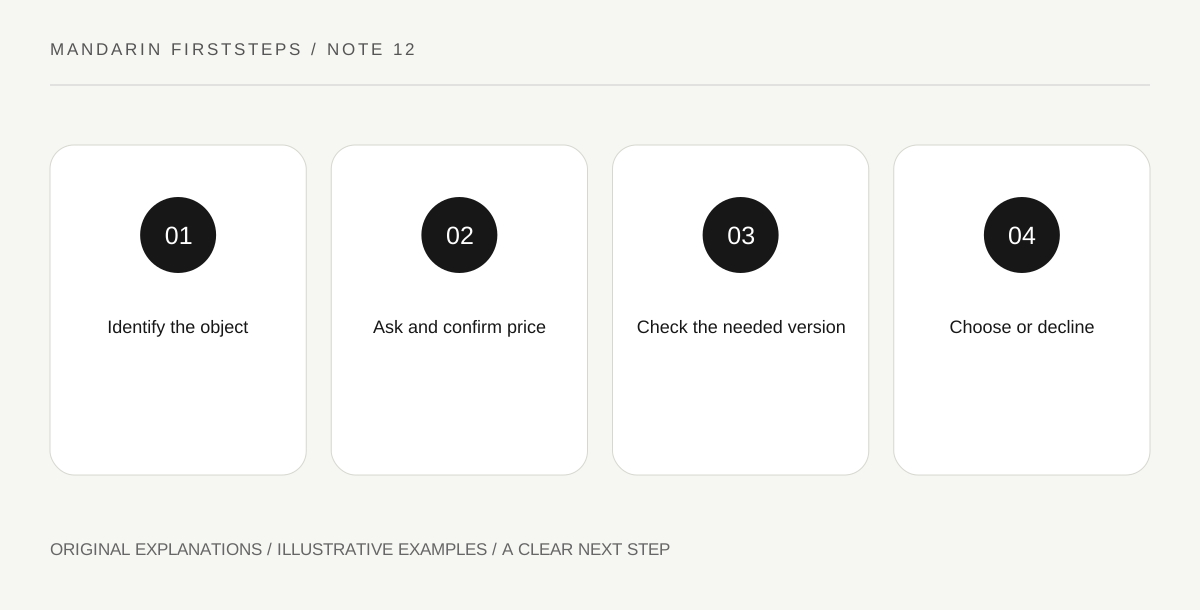
Original explanatory diagram. Read the full method and limitations below.
Make the referent visible
Zhège, 这个, means this one; nàge, 那个, means that one. In a shop, these words work best with a clear gesture or a visible item. If several similar objects are close together, a vague this can lead to an answer about the wrong one. Pick up or indicate the intended item only in ways the setting permits.
Create a practice table with three different objects. The customer points and says Zhège. The seller deliberately checks which one before answering. This small clarification is a realistic skill: the grammar can be correct while the referent remains uncertain. Add the object’s name as your vocabulary grows.
Ask the price and hear the complete amount
Zhège duōshao qián, 这个多少钱, asks how much this costs. Learn duōshao qián as a question chunk and prepare to hear a number in reply. Prices may be spoken in shortened everyday forms, so practise with written prices first and ask for written digits when you are unsure.
Use clearly illustrative prices and label the relevant currency in the exercise. Repeat the amount with the item to verify that it is a unit price rather than a total for several pieces. Avoid automatically bargaining: whether negotiation is appropriate depends on the shop and situation, not on a universal cultural rule.
Ask about a version rather than assuming it exists
Yǒu dà yìdiǎn de ma, 有大一点的吗, asks whether there is a slightly larger one. Yǒu xiǎo yìdiǎn de ma asks about a smaller one. These are useful chunks, but clothing labels, fit and product dimensions cannot be settled by one comparative phrase. Check the actual item and applicable store information.
For a role-play, place a small and large notebook on the table. Ask for the larger version and confirm which object the seller presents. Then remove the large notebook and practise accepting that it is unavailable. This makes the question a genuine inquiry rather than a script that always produces the desired object.
Decline and close the exchange politely
A useful beginner can say Xièxie, wǒ zài kànkan, 谢谢,我再看看, thank you, I will look around some more. You do not need to invent a long excuse. Politeness does not oblige you to purchase, share contact details or accept an item you do not want.
Finish the exercise by choosing among buy, ask another question, and leave. Explain the choice in English if necessary, then use a short Mandarin closing. Separating a consumer decision from the language drill keeps the practice honest. A successful exchange may simply establish the price and confirm that the item is unsuitable.
Illustrative notebook purchase
At a practice stall, a learner points to a blue notebook and asks Zhège duōshao qián? The seller gives a price. The learner confirms the amount, then asks Yǒu dà yìdiǎn de ma? The larger notebook has a different price, so they check again rather than assuming the original amount applies. They decide to keep looking and close with a brief thank-you.
Practical checks
Optional checkboxes save only in this browser.
Questions that come up
Should every Mandarin shopping exercise include bargaining?
No. Many shops use fixed prices, and negotiation practices vary. Beginner lessons should teach asking and confirming first. Follow the actual setting rather than treating bargaining as a required performance of cultural knowledge.
Can a size word replace trying or measuring an item?
No. Larger and smaller are comparisons, not standardized product measurements. Use the real dimensions, fit information or appropriate in-store checks to decide whether the item meets your needs.
References and scope
These sources support the factual background. Examples and exercises are original illustrative teaching material. References do not imply endorsement.
- Open University: Getting started with Chinese 1 — Beginner greetings, pronouns, pinyin, tones and numbers.
- Open University: Asking questions with what and where — Question words in their corresponding statement positions.
- Open University: Beginners’ Chinese audio collection — Beginner conversation topics including directions, buying things, restaurant orders and invitations.