Recover when you miss a word in Mandarin
Not understanding is a normal part of beginner conversation. A small set of clarification phrases lets you stay in the exchange without pretending. Learn to ask for repetition, request a slower version, identify the missing part and confirm what you finally understood.
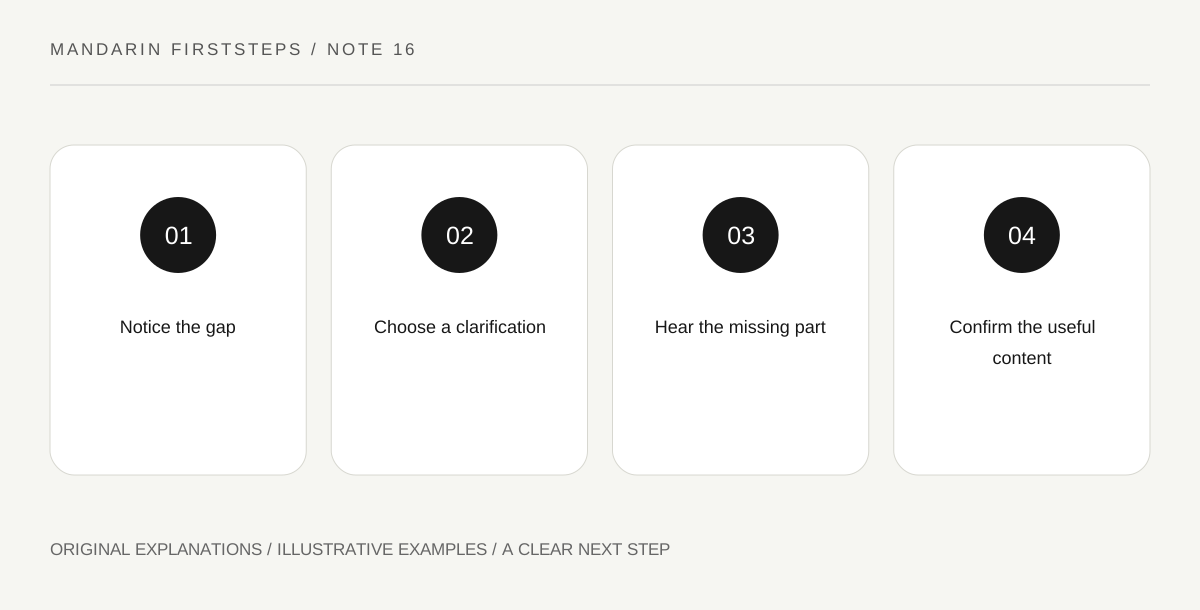
Original explanatory diagram. Read the full method and limitations below.
Ask for a repeat before guessing
Qǐng zài shuō yí biàn, 请再说一遍, means please say it again. Learn it as one accessible phrase so you can use it while attention is already strained. A brief puzzled pause may be understood, but an explicit request gives the other person a clearer way to help.
Practise using the phrase deliberately in an easy conversation, not only when you are completely lost. A partner says a known sentence slightly softly, and you request a repeat. The partner repeats naturally. This builds the habit of asking before an incorrect guess becomes the basis for the next several turns.
Request a manageable pace
Qǐng shuō màn yìdiǎn, 请说慢一点, asks someone to speak a little more slowly. Slower speech helps some problems, but not all. If you do not know a key word, hearing it slowly five times may not supply its meaning. Combine pace control with a request to show, write or rephrase the relevant part.
Ask a partner to repeat in short meaningful chunks rather than stretch every syllable unnaturally. For a simple plan, the chunks might be tomorrow afternoon, at the library, and study Chinese. You can then identify which chunk is unclear. This preserves the structure of the message while reducing memory demands.
Separate sound problems from meaning problems
You may fail to hear the sounds, know the sounds but not the word, or understand the words but not the speaker’s intention. Those problems need different responses. Repetition addresses the first; an explanation or visible object may address the second; a specific confirmation question can address the third.
After a practice exchange, label one breakdown in English: sound, word meaning or intended action. Then choose the smallest useful clarification. This reflection should be brief. Its purpose is to make the next attempt more effective, not to produce a long record of every syllable you failed to recognize.
Repeat the understood content
When you think you understand, say the relevant content back: a number, date, item or destination. Add Duì ma, 对吗, right, if the context fits. The other person can then correct the exact misunderstanding. A general okay reveals less than repeating the information that will guide your next action.
For practice, use an information-gap task with a built-in error. One partner states an illustrative meeting time, the other repeats a different one, and they repair the mismatch. Switch roles. Success means the final shared record is correct; it does not require uninterrupted speech or hiding the need for help.
Illustrative clarification sequence
A learner hears a plan but misses its time. They say Qǐng zài shuō yí biàn. The partner repeats too quickly, so the learner adds Qǐng shuō màn yìdiǎn. They recognize tomorrow afternoon and repeat Míngtiān xiàwǔ, duì ma? The partner confirms. The learner asks separately about the hour instead of claiming to understand the whole plan.
Practical checks
Optional checkboxes save only in this browser.
Questions that come up
Will asking for repetition seem impolite?
A brief polite request is an ordinary part of communication. It is generally more useful than pretending and creating confusion. Consider the setting and the other person’s time, and use written support if repeated attempts are not resolving the problem.
Should I switch to English immediately?
Use whichever shared resources help accomplish the real task. In practice, try one targeted clarification first. In an important real exchange, clarity takes priority over maintaining a Mandarin-only rule.
References and scope
These sources support the factual background. Examples and exercises are original illustrative teaching material. References do not imply endorsement.
- Open University: Getting started with Chinese 1 — Beginner greetings, pronouns, pinyin, tones and numbers.
- MIT OpenCourseWare: Chinese I, Fall 2014 — Integrated pronunciation, basic characters and practical everyday conversation; communicative practice.
- Open University: Beginners’ Chinese audio collection — Beginner conversation topics including directions, buying things, restaurant orders and invitations.