Use pinyin as a sound map, not English spelling
Pinyin uses familiar letters to represent Mandarin sounds. Familiar appearance can mislead English readers, especially with q, x, zh and ü. Learn the system through syllables and recordings so that the written form points you toward Mandarin rather than an English approximation.
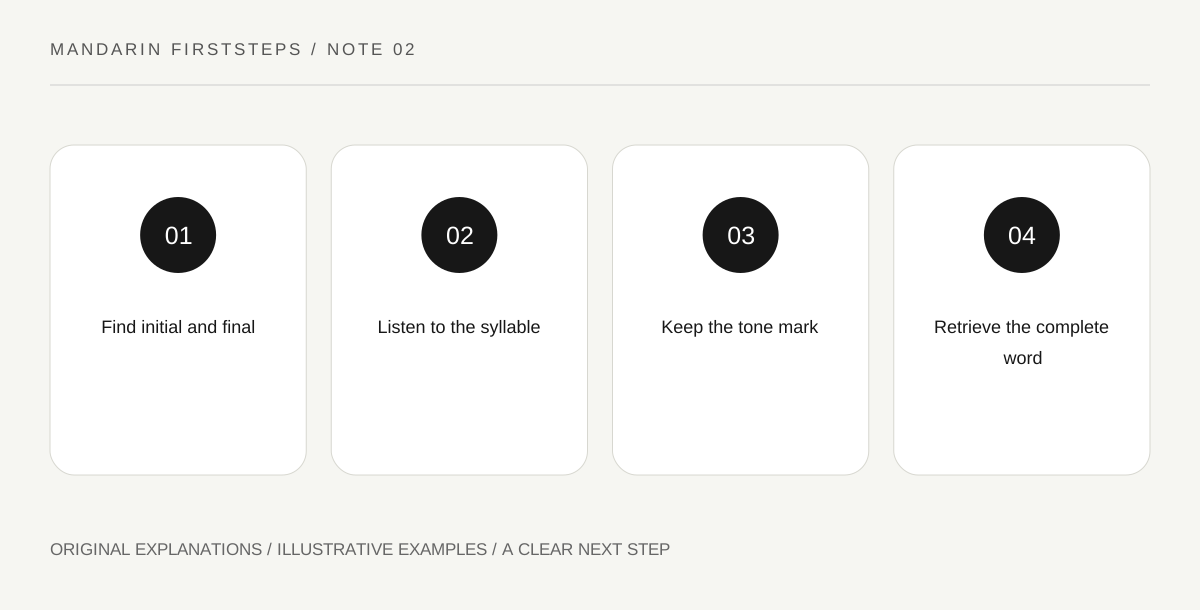
Original explanatory diagram. Read the full method and limitations below.
Divide a syllable into useful parts
A Mandarin syllable often has an initial consonant and a final containing the vowel sounds. In mā, m is the initial and a is the final. Some syllables have no initial. Thinking in these parts makes a sound chart manageable: you can compare a small group of initials with the same final, instead of treating hundreds of syllables as unrelated spellings.
Use one chart that includes audio and keep its transcription conventions consistent. Listen to a row, repeat a few items, and then choose one familiar word containing the sound. The point is not to recite a chart at speed. It is to connect the spelling to an audible distinction you can recognize again.
Notice aspiration rather than English voicing
Pairs such as b and p are not simply the same contrast as English b and p in every position. In Mandarin the amount of released air is important. A light piece of tissue held in front of the mouth can make a stronger puff visible, but it cannot judge the whole pronunciation. Use it as a limited observation, alongside listening.
Compare bā and pā with a model. Keep the vowel and tone stable while attending to the initial. If both become English-like voiced consonants, slow down and imitate only the release. Add the rest of the syllable after the initial distinction becomes comfortable. A teacher can correct tongue position that a tissue cannot reveal.
Give unfamiliar spellings their own practice
The pinyin letters j, q and x do not represent ordinary English letter names. Likewise zh, ch and sh form a different series from z, c and s. Written descriptions of tongue position can help, but they are insufficient without sound. Avoid inventing a permanent English spelling such as chee for every syllable that begins with q.
The vowel ü is another important example. Keep a rounded lip shape while approaching the tongue position of a front vowel. In standard pinyin spelling, the dots are omitted after j, q and x; the spelling rule does not turn the sound into the ordinary u vowel. Learn a real word rather than relying on that sentence alone.
Read words with tone marks
A pinyin word is incomplete as a pronunciation aid if tones have disappeared. Keep tones when copying a new word, and notice neutral-tone syllables that do not carry one of the four full lexical tones in the same way. Word spacing groups meaningful units, while apostrophes can clarify syllable boundaries in spellings such as Xī’ān.
For practice, select five words from a beginner lesson. Read them, listen, circle one mismatch and read them again. Then hide the pinyin and use the characters or meanings as prompts. Pinyin is scaffolding: it should make sound available while your listening and character recognition gradually become stronger.
Illustrative spelling audit
Maya copies qù, to go, as 'choo' in her notebook. That English reminder starts to replace the model. She changes the entry to 去 qù, adds a recording reference, and practises Wǒ qù, I go. She compares q with j in separate audio examples, concentrating on the release of air. Her note now directs her back to Mandarin sounds.
Practical checks
Optional checkboxes save only in this browser.
Questions that come up
Should I write my own English sound spellings?
A temporary reminder can help you remember a sensation, but English spelling cannot reliably represent Mandarin contrasts. Keep the standard pinyin and a sound reference as the main entry, and remove a reminder when it starts producing errors.
Is pinyin only for complete beginners?
No. It remains useful for dictionaries, typing and pronunciation notes at later levels. The aim is to use it accurately while also developing direct recognition of characters and spoken words.
References and scope
These sources support the factual background. Examples and exercises are original illustrative teaching material. References do not imply endorsement.
- Open University: Getting started with Chinese 1 — Beginner greetings, pronouns, pinyin, tones and numbers.
- Open University: Beginners’ Chinese taster course — Scripts, word formation, introductions, nationalities and telephone numbers.
- MIT OpenCourseWare: Chinese I, Fall 2014 — Integrated pronunciation, basic characters and practical everyday conversation; communicative practice.