Hear Mandarin tones before trying to sing them
Mandarin tones belong to words. A beginner needs to hear and produce meaningful differences, rather than give every syllable an exaggerated melody. Start with a small set of syllables, connect sound to meaning, and then carry the contrast into short phrases.
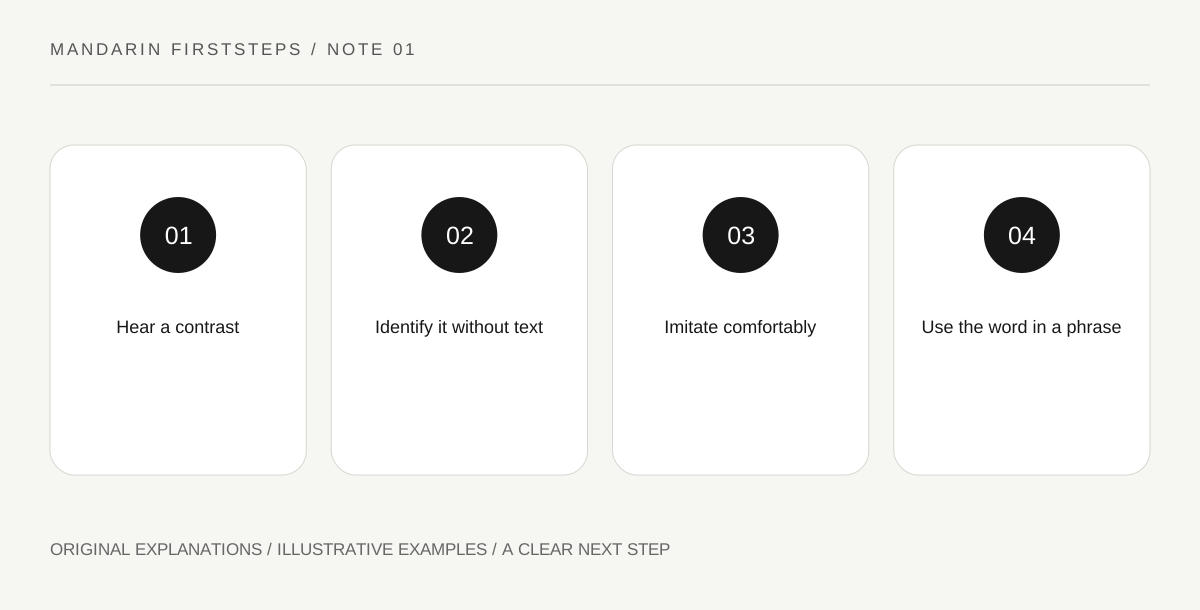
Original explanatory diagram. Read the full method and limitations below.
Keep the syllable constant
The familiar teaching set mā, má, mǎ and mà lets you change pitch while keeping the consonant and vowel similar. They illustrate first, second, third and fourth tones. First tone is relatively high and level; second rises; third is low and may dip and rise in isolation; fourth falls. These descriptions are guides to listening, not musical notes that every speaker must match.
Listen to a reliable recording before reading a pitch diagram. Point to one of four written choices as you hear it. If you identify only two correctly, reduce the exercise to that pair. A shorter successful distinction is more useful than repeatedly guessing among four labels.
Separate hearing from imitation
Recognition and production are different tasks. You may hear a contrast you cannot yet produce, or imitate one immediately without recognizing it later. Give each task its own turn: first identify a sound, then repeat a model, then retrieve the sound after a pause. Avoid looking at the answer during the recognition turn.
Record a few attempts with the same ordinary speaking voice. Compare whether your pitch moved in the intended direction and whether the vowel remained clear. Do not force the highest or lowest part of your voice. If a tone becomes strained, shorten the session and ask a teacher for a comfortable model.
Move into two-syllable words
Words such as kāfēi, coffee, and míngtiān, tomorrow, put tones into sequences. The second syllable begins from a context created by the first, so a phrase will not sound like isolated dictionary entries joined together. Practise the complete word with a recording and remember its meaning at the same time.
Third-tone behavior deserves patience. Before another third tone, the first is commonly pronounced with a rising contour, as in nǐ hǎo. In other contexts a third tone is often simply low. Keep dictionary tone marks in your notes and distinguish them from what you hear in connected speech.
Use a meaning check
Make a card with a picture, a tone-marked word and one short phrase. Hide the writing and name the picture. Then listen again. This prevents tone practice from becoming a sequence of numbers disconnected from communication. A listener should eventually recognize the intended word, not just agree that your pitch moved.
For a five-minute exercise, identify six recorded items, imitate three words, and use one in a phrase. Note the pair that caused confusion. Repeat that pair on another day with a different speaker. Improvement means the contrast survives a new voice and a delay, not that one recording feels familiar.
Illustrative tone session
A learner confuses second and fourth tones. They compare má and mà, marking an upward arrow for the first and a downward arrow for the second. After listening without text, they correctly identify four of six items. They then practise míngtiān as a word and say Míngtiān jiàn, see you tomorrow. The next session begins with fresh examples rather than a longer list.
Practical checks
Optional checkboxes save only in this browser.
Questions that come up
Do I need perfect tones before speaking?
No. Begin with small exchanges while continuing focused listening. Ask for feedback on the word that was misunderstood; a specific correction gives you a more useful practice target than a general demand to sound native.
Can an English question intonation replace a Mandarin tone?
No. Sentence intonation and lexical tone interact, but changing every final syllable into an English-style question rise can obscure words. Learn short questions from recorded models and preserve the words’ tone patterns.
References and scope
These sources support the factual background. Examples and exercises are original illustrative teaching material. References do not imply endorsement.
- Open University: Getting started with Chinese 1 — Beginner greetings, pronouns, pinyin, tones and numbers.
- Open University: Beginners’ Chinese taster course — Scripts, word formation, introductions, nationalities and telephone numbers.
- MIT OpenCourseWare: Chinese I, Fall 2014 — Integrated pronunciation, basic characters and practical everyday conversation; communicative practice.