Learn your first characters through words you can use
A character is a written unit, and a useful Mandarin word may contain one character or several. Start with words you already know by sound, connect their written forms to meaning, and notice recurring components without assuming every component supplies an exact definition or pronunciation.
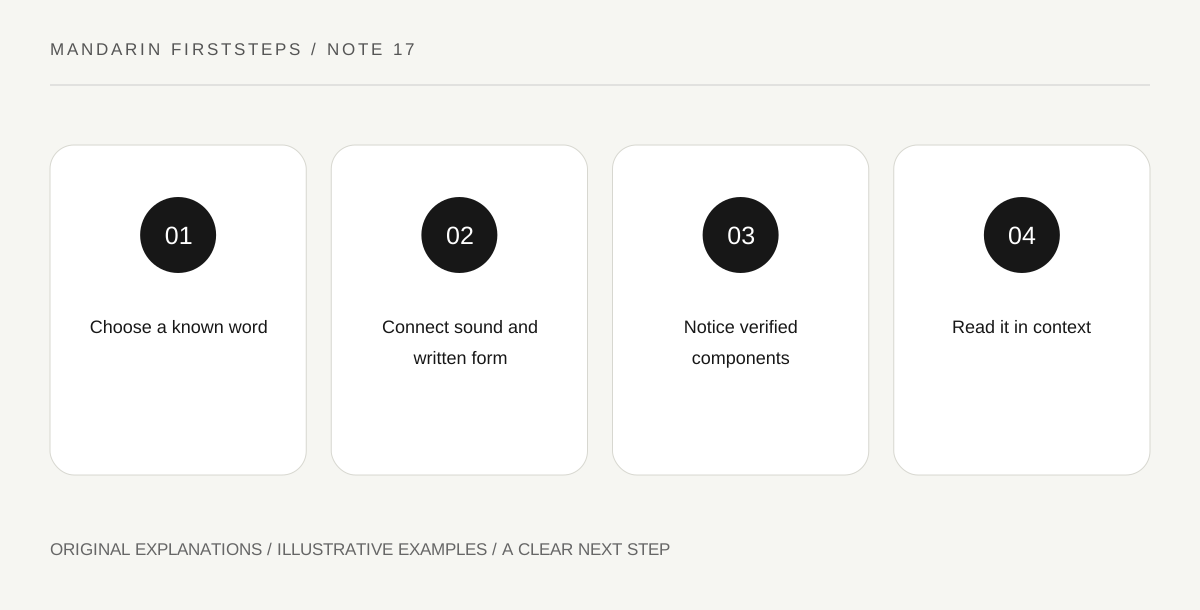
Original explanatory diagram. Read the full method and limitations below.
Attach writing to a known spoken word
If you already know shuǐ, water, learn 水 with that sound and meaning. If you know xuésheng, student, learn 学生 as a word containing two characters. This connection prevents the writing system from becoming a separate collection of pictures unrelated to your speaking and listening vocabulary.
Choose five useful words from your recent conversations. Write the characters, pinyin and meaning on separate sides or fields of a card. Test recognition from characters to meaning and from a picture to the spoken word. Do not count a copied page as evidence that you can recognize the word later.
Notice components without inventing stories as facts
Components can provide helpful patterns across characters, but their functions and historical development are more complex than an attractive visual story. Some components relate to meaning and others to sound, often imperfectly in modern Mandarin. A mnemonic you invent is a personal memory aid, not an established etymology.
For a small exercise, circle a repeated component in two characters and consult a reliable dictionary or teacher about its role. Record only what you verified. If you make a playful story to remember the shape, label it as your own. This keeps a useful study technique from spreading false explanations.
Distinguish simplified and traditional forms
Mandarin can be written using simplified or traditional character forms, with different regional conventions. The spoken language and the script choice are related but not identical categories. Pick the system used in your course or intended reading environment, then learn to recognize common alternative forms as they become relevant.
Avoid mixing forms accidentally on one learning card. If you include both, label each clearly and verify the correspondence. Not every difference is a single simple stroke substitution, and conversion tools can miss context-sensitive choices. Your first goal is consistent recognition of a small useful set, not instant mastery of both systems.
Practise recognition in a tiny context
A word on an isolated flashcard may be easy while the same word on a sign feels unfamiliar. Put your new words into short phrases you understand, or make a small menu with three known items. Change font size and layout after you know the basic form so you can recognize it beyond one familiar card.
If handwriting matters to your goals, learn stroke order from a reliable model and write a few attentive attempts. If your immediate goal is reading, give recognition its own practice rather than requiring extensive copying first. Both skills can develop, but they need different evidence: identifying a word is not the same as producing its shape from memory.
Illustrative five-word reading set
A learner chooses 水, 茶, 学生, 中文 and 今天 because they already use the spoken words. They match each to a meaning, then read a small practice card containing 今天学中文. They initially identify 学生 whenever they see 学, so they compare the full words and their second characters. The exercise targets the actual confusion rather than adding twenty more cards.
Practical checks
Optional checkboxes save only in this browser.
Questions that come up
Must I learn hundreds of characters before speaking?
No. Speaking, listening and character learning can develop together. Begin with a manageable set linked to useful spoken words, while using pinyin accurately as support. A character count alone does not measure conversational ability.
Are all Chinese characters pictures?
No. Modern characters have varied structures and histories. Some visual mnemonics are memorable, but treating every character as a literal picture leads to misleading explanations. Use a reliable reference when making claims about origins.
References and scope
These sources support the factual background. Examples and exercises are original illustrative teaching material. References do not imply endorsement.
- Open University: Beginners’ Chinese taster course — Scripts, word formation, introductions, nationalities and telephone numbers.
- Open University: Getting started with Chinese 2 — Everyday activities, sentence order, time expressions, questions and choices.
- MIT OpenCourseWare: Chinese I, Fall 2014 — Integrated pronunciation, basic characters and practical everyday conversation; communicative practice.