Say where someone is and where an action happens
A beginner can use zài to locate a person, then extend that idea to where an activity takes place. The two sentence patterns are closely related but have different jobs. Learn them with a room sketch and familiar actions rather than a long list of disconnected place words.
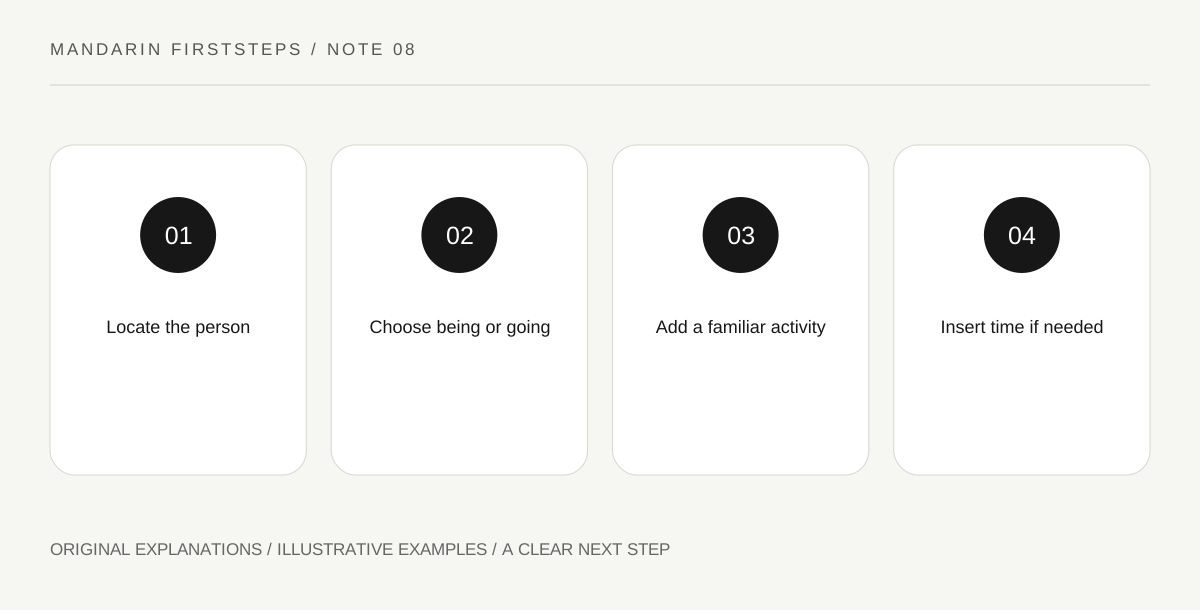
Original explanatory diagram. Read the full method and limitations below.
Locate a person with zài
Wǒ zài jiā, 我在家, means I am at home. Tā zài xuéxiào, 他在学校, means he is at school. In these sentences zài connects the person with a location; English supplies am or is in its translation. Do not insert shì before zài simply to account for the English word is.
Draw a small map showing home, school and a café. Place a token on one location and say where the person is. Then move the token and change only the place phrase. This visual exercise isolates the pattern from the harder task of remembering several new verbs or explaining a real route.
Put the activity after the place phrase
Wǒ zài jiā kàn shū, 我在家看书, means I read at home. The location phrase comes before the activity in this basic pattern. Compare that with Wǒ zài jiā, which only states where I am. Keeping the two examples side by side shows what the action adds.
Build three sentences about the same location: reading at home, studying Chinese at home and drinking tea at home. Then keep the activity constant and change the place. By varying one piece at a time, you can see whether a mistake comes from sentence order or from not knowing the word for a destination.
Distinguish being somewhere from going there
Qù, 去, means go. Wǒ qù xuéxiào says I go to school, while Wǒ zài xuéxiào says I am at school. A movement arrow and a stationary dot can make the contrast memorable. An English phrase such as at the station cannot be translated by choosing a word without considering what the sentence says about the person.
Ask two separate questions of the map: Nǐ zài nǎr, where are you, and Nǐ qù nǎr, where are you going. Give your partner a current-location card and a destination card. They must choose the correct card to answer each question. This makes an otherwise abstract verb contrast concrete.
Add time only after the location pattern is stable
Once a person–place–action sentence feels manageable, add a time before the location phrase: Wǒ míngtiān zài jiā xué Zhōngwén, I study Chinese at home tomorrow. It is a useful beginner sequence: person, time, place, action. Other Mandarin constructions exist, so treat this as a dependable starting pattern.
To practise understanding, listen to three sentences and fill a chart with who, when, where and activity. Leave a question mark for information you did not hear. Ask a focused follow-up rather than invent a missing detail. The final chart should match the spoken plan, not a story inferred from the pictures.
Illustrative location puzzle
Nora’s token is in a café, but her destination card shows home. Asked Nǐ zài nǎr, she says Wǒ zài kāfēiguǎn, 我在咖啡馆. Asked Nǐ qù nǎr, she says Wǒ qù jiā, 我去家, which her teacher improves to the more idiomatic Wǒ huí jiā, 我回家, I am going home. Useful patterns still need word-specific usage.
Practical checks
Optional checkboxes save only in this browser.
Questions that come up
Does zài always mean at?
No. Zài has several grammatical uses, including a role in describing ongoing actions. This lesson concerns location. Learn the current pattern well and give later uses their own examples rather than expecting one English word to explain all of them.
Can I put the location at the end like English?
For the basic place-of-action sentences here, use the location before the verb. Mandarin also has other location structures, but moving the phrase freely on the basis of English word order is not a reliable beginner strategy.
References and scope
These sources support the factual background. Examples and exercises are original illustrative teaching material. References do not imply endorsement.
- Open University: Getting started with Chinese 2 — Everyday activities, sentence order, time expressions, questions and choices.
- Open University: Location, location, location — Using location phrases in simple descriptions of activities.