Listen for one answer before transcribing every word
A beginner listening task becomes more useful when it has a clear purpose. Instead of trying to write every syllable, decide whether you need a time, place, item or action. Listen for that answer first, then use a transcript to investigate the part that prevented understanding.
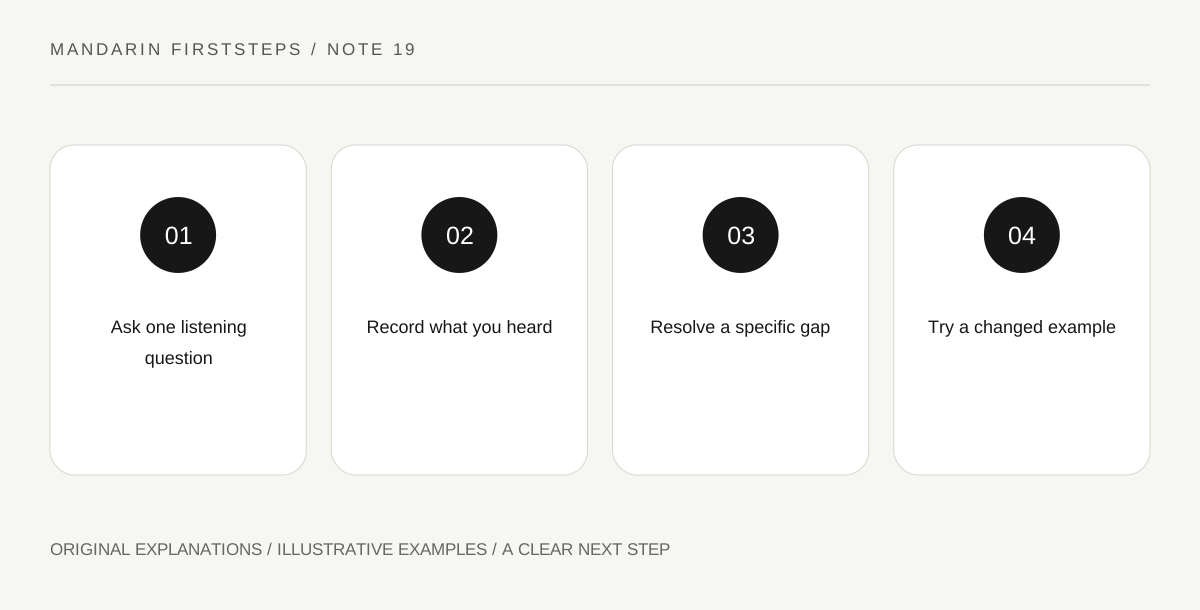
Original explanatory diagram. Read the full method and limitations below.
Set a narrow listening question
Choose a short recording appropriate to your level and ask one concrete question, such as where the speaker is going. A narrow task gives attention a direction. It also makes success observable: you either identified the destination or you did not. Simply listening until the audio feels familiar can conceal how little meaning you retrieved.
Before playing, predict the type of answer without guessing the specific answer. You might expect a place name, not necessarily the library. This distinction matters. A prediction about form helps you notice relevant information; a strong guess about content can make you hear what you expected rather than what the speaker said.
Use repeated listening for different jobs
On the first pass, identify the broad situation. On the second, answer the chosen question. On a third, focus on the short stretch containing the answer. This sequence is an optional practice method, not a scientifically fixed number of listens. Stop when additional repetition no longer changes what you understand.
Write a question mark for uncertainty rather than filling a gap with a confident invention. If you heard afternoon but missed the hour, record that distinction. The uncertain part becomes the target for transcript checking or teacher feedback. Your notes should show what the audio actually established.
Open the transcript with a specific problem
A transcript is most helpful after you know what you were trying to hear. Compare the missed stretch with the text. Was the word unknown, a familiar word pronounced in connected speech, or a sentence pattern you had not recognized? Those are different learning needs and should lead to different next steps.
For a known word, listen again while following the text, then hide it and listen once more. For a new word, add only the useful item to your notes. Avoid converting every recording into an enormous vocabulary list. The aim is to improve the next listening attempt, not archive the entire lesson.
Test transfer with a changed detail
After practising one clip, try a similar short exchange with a different time or place. If you can only answer from the original, you may have memorized the recording rather than strengthened the pattern. A partner can make a fresh sentence using the same vocabulary and one changed detail.
Keep the task manageable enough that you can explain why an answer is correct. If every sentence is overwhelmingly unfamiliar, choose easier material with clearer context. Difficulty alone does not guarantee learning. A successful session leaves you with one better-recognized word, phrase or pattern and a way to check it later.
Illustrative listening notebook
A learner hears a short study plan and asks only where the activity happens. They identify home but miss the day. The transcript shows the place phrase zài jiā, which they replay and recognize. A partner then changes home to school while keeping the action. The learner correctly updates the place, showing that they are attending to the phrase rather than reciting a remembered answer.
Practical checks
Optional checkboxes save only in this browser.
Questions that come up
Is using subtitles cheating?
No. Text can support learning, but it changes the task. Try an appropriate short stretch without text first, then use the transcript deliberately and retest without it. This lets you distinguish reading support from independent listening.
Should I understand every word before moving on?
Not always. For a narrow task, understanding the requested information can be enough. Investigate a few useful gaps, then choose whether more work on the same clip is likely to help your current goal.
References and scope
These sources support the factual background. Examples and exercises are original illustrative teaching material. References do not imply endorsement.
- Open University: Getting started with Chinese 1 — Beginner greetings, pronouns, pinyin, tones and numbers.
- Open University: Getting started with Chinese 2 — Everyday activities, sentence order, time expressions, questions and choices.
- MIT OpenCourseWare: Chinese I, Fall 2014 — Integrated pronunciation, basic characters and practical everyday conversation; communicative practice.
- Open University: Beginners’ Chinese audio collection — Beginner conversation topics including directions, buying things, restaurant orders and invitations.