Build a beginner practice week around useful tasks
A realistic Mandarin routine connects short study sessions to things you want to understand or say. Combine sound work, useful sentence patterns, listening and a few characters. Measure progress by completed communication tasks and retained knowledge rather than a promise to become fluent within a fixed number of days.
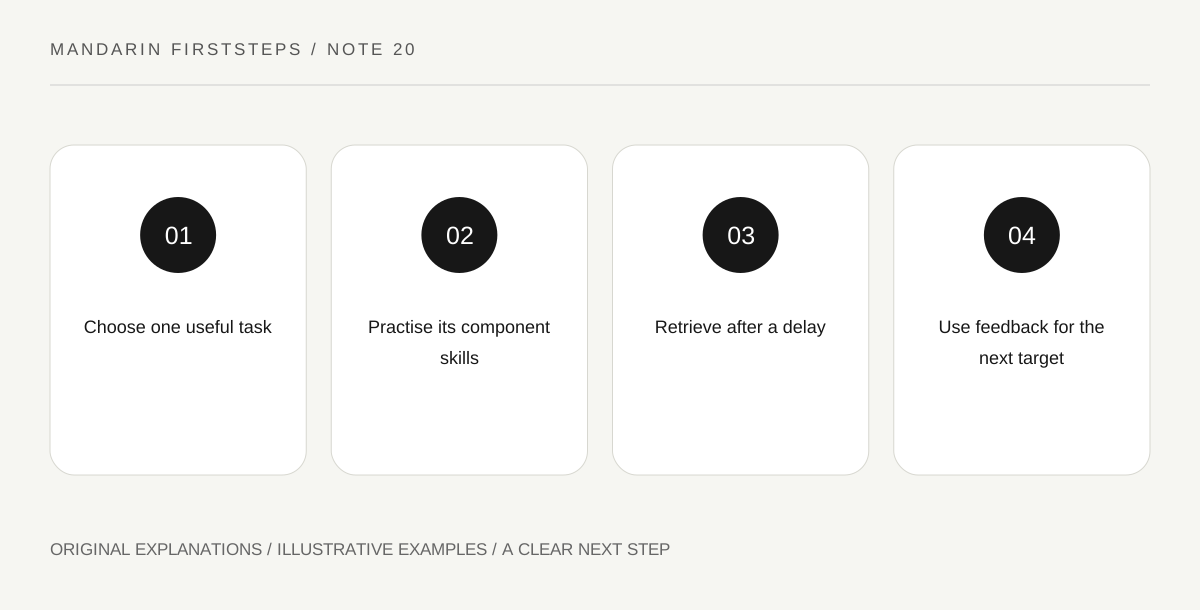
Original explanatory diagram. Read the full method and limitations below.
Choose a small communicative target
A target might be introducing yourself, ordering a familiar drink or understanding a proposed meeting time. Define the task narrowly enough to rehearse. Speak Mandarin more confidently is a direction, while give my name and ask for the other person’s name is a concrete task with a visible outcome.
List the vocabulary and patterns the task actually needs. An introduction may require a greeting, name phrase, one fact and a clarification request. It does not require every country, profession and family term in a beginner textbook. Keep optional expansion separate so that preparation does not grow faster than your ability to use it.
Give different skills distinct turns
A short session can include listening to a model, identifying a sound contrast, speaking without text and recognizing a few written words. These activities support each other but are not interchangeable. Copying characters does not test listening; repeating immediately after audio does not test retrieval after a delay.
For an illustrative fifteen-minute session, spend a few minutes on yesterday’s words, a few on a short recording, a few on the target exchange and the remainder on a handful of characters. Adjust the distribution to your goal and energy. The numbers are a sample schedule, not a prescribed effective dose.
Review by retrieving before checking
Look at a picture or English prompt and try to produce the Mandarin phrase before revealing your notes. Then check the sound and tone marks. Retrieval reveals what you can access independently. Rereading familiar material may feel smooth while leaving you unable to say the phrase when a real person asks.
Bring older items back into later sessions instead of confining them to one study day. Mix a previous time expression into a new location sentence. If an item repeatedly fails, simplify its context or ask for a correction. Do not add more cards merely to maintain an impressive daily count.
Check a task with a new partner or detail
At the end of the week, attempt the target exchange with the script hidden. Change one name, drink or time. Ask the listener what they understood, and note the exact gap. Feedback on one misunderstood word is more actionable than a broad judgment that your Mandarin is good or bad.
Use that result to choose the next week’s work. If you can speak the order but cannot understand the reply, add listening choices. If the reply is clear but your quantity is misunderstood, revisit numbers and measure words. Progress is uneven across skills, and the next useful task follows the evidence of the exchange.
Illustrative one-week target
A learner chooses to arrange a short study meeting. Monday focuses on days and parts of day; Tuesday on two clock times; Wednesday on listening to alternative plans; Thursday on asking for a repeat; Friday on a short role-play. At the weekend, a partner changes the time unexpectedly. The learner clarifies successfully but misses the location, which becomes the next target.
Practical checks
Optional checkboxes save only in this browser.
Questions that come up
How quickly should a beginner become conversational?
There is no reliable universal timeline. Prior language experience, time, instruction, opportunities and the meaning of conversational all vary. Track specific tasks you can complete and understand, and expand them steadily without treating a date as a guarantee.
Should I study every skill equally each day?
No. Balance over time is more useful than identical daily blocks. A travel request, reading goal or pronunciation problem may justify different emphasis, while continued listening and speaking keep written knowledge connected to actual language use.
References and scope
These sources support the factual background. Examples and exercises are original illustrative teaching material. References do not imply endorsement.
- Open University: Getting started with Chinese 1 — Beginner greetings, pronouns, pinyin, tones and numbers.
- Open University: Beginners’ Chinese taster course — Scripts, word formation, introductions, nationalities and telephone numbers.
- Open University: Getting started with Chinese 2 — Everyday activities, sentence order, time expressions, questions and choices.
- MIT OpenCourseWare: Chinese I, Fall 2014 — Integrated pronunciation, basic characters and practical everyday conversation; communicative practice.