Make a clear hotel request without a long prepared speech
A hotel conversation becomes manageable when you divide it into one purpose at a time. State that you have a booking, show the relevant information, and ask one practical question. Keep identity documents and payment details out of casual language practice and use fictional records for rehearsal.
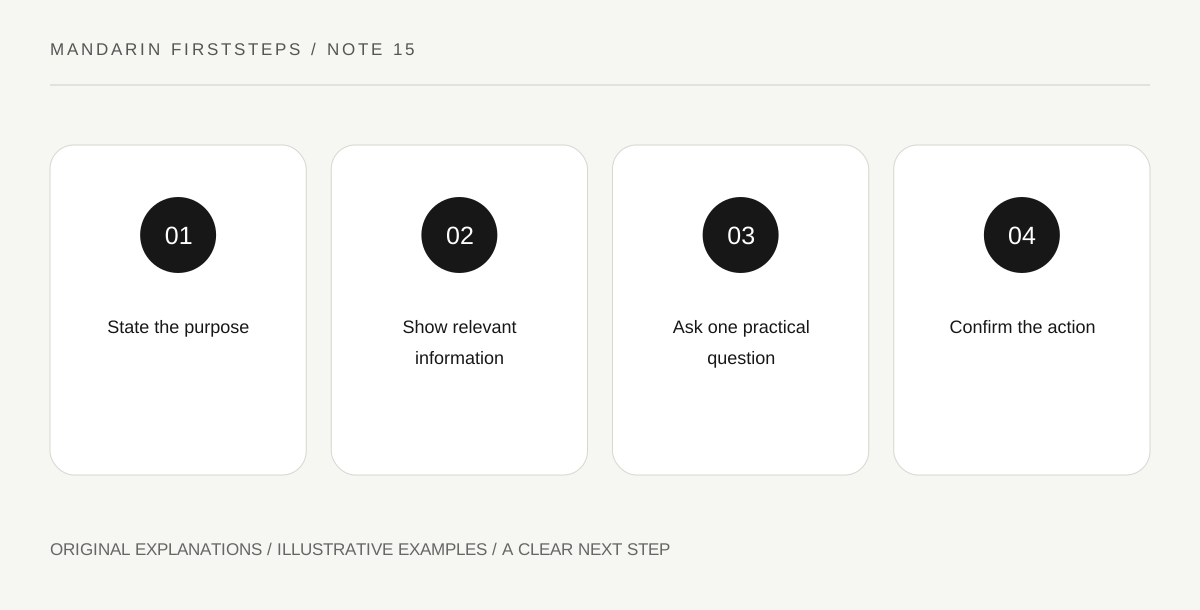
Original explanatory diagram. Read the full method and limitations below.
State the purpose briefly
Wǒ yǒu yùdìng, 我有预订, means I have a reservation. The phrase establishes the task without explaining the whole journey. Follow the hotel’s actual check-in procedure and show the booking confirmation when requested appropriately. A spoken name may be difficult to identify across languages, so written booking details can reduce confusion.
Practise with a fictional reservation card containing a name, dates and room type. The receptionist checks one field at a time. This is useful language work without exposing a real booking code, identity document or card number in a classroom, shared notebook or public screenshot.
Ask where a facility is
Zǎocāntīng zài nǎr, 早餐厅在哪儿, asks where the breakfast room is. Diàntī zài nǎr, 电梯在哪儿, asks where the elevator is. These questions use a familiar location pattern with new nouns. Choose two facilities you genuinely need rather than memorize a long inventory of hotel vocabulary.
Ask the question while looking at a simple floor plan. The receptionist points and gives a short answer. Repeat the location or trace the route. If floor numbering or building layout is unfamiliar, confirm against the actual signs instead of assuming that a translation of a floor number resolves every difference.
Request an item with a visible quantity
Wǒ xiǎng yào yì tiáo máojīn, 我想要一条毛巾, means I would like one towel. Measure words vary with the item; learn this as a complete useful phrase. You can also show an item or picture when its name is unknown. A clear quantity helps staff distinguish a replacement from an additional set.
In practice, prepare towel, water and pillow cards with different quantities. The guest makes one request, and the receptionist repeats it. Change one detail on a second round. Do not add unrelated requests until the listener has confirmed the first; otherwise an apparently successful exchange may hide a missed item.
Describe a problem without diagnosing it
Kòngtiáo bù gōngzuò, 空调不工作, is a simple way to say the air conditioning is not working. Name what you observe rather than guessing a technical cause. Show the room number through the hotel’s normal process and ask for help. A beginner does not need repair vocabulary to communicate an ordinary service problem.
For a final role-play, the guest reports a problem, the receptionist asks a clarifying question, and the guest confirms the intended action. If real instructions involve equipment, access or safety, ask staff to demonstrate or provide clear written guidance. The language lesson should not turn uncertain comprehension into a reason to attempt a repair.
Illustrative room request
A guest says Wǒ yǒu yùdìng and shows a fictional booking. After check-in, the guest asks Diàntī zài nǎr and follows the route on a floor plan. Later, they request one towel. The receptionist repeats two towels, so the guest corrects the quantity to yì tiáo. Three short exchanges accomplish more than one speech containing every possible request.
Practical checks
Optional checkboxes save only in this browser.
Questions that come up
Should I memorize an entire check-in dialogue?
Learn a short opening and the key information you may need to recognize. Actual procedures differ. Flexible questions, written booking details and clarification are more useful than a dialogue whose next line you cannot change.
Can a translation app help with a complex request?
It can support an exchange, particularly when both people can inspect the text. Check that names, dates and requested actions remain correct, and ask staff for clarification when the result is important or confusing.
References and scope
These sources support the factual background. Examples and exercises are original illustrative teaching material. References do not imply endorsement.
- Open University: Getting started with Chinese 1 — Beginner greetings, pronouns, pinyin, tones and numbers.
- Open University: Asking questions with what and where — Question words in their corresponding statement positions.
- Open University: Location, location, location — Using location phrases in simple descriptions of activities.
- Open University: Beginners’ Chinese audio collection — Beginner conversation topics including directions, buying things, restaurant orders and invitations.