Ask directions to one landmark and repeat the first step
Directions are demanding because the answer can contain several unfamiliar places and actions in quick succession. Begin with one destination and a few core movement words. Your first goal is to understand the next useful step, then confirm enough of the route to proceed confidently.
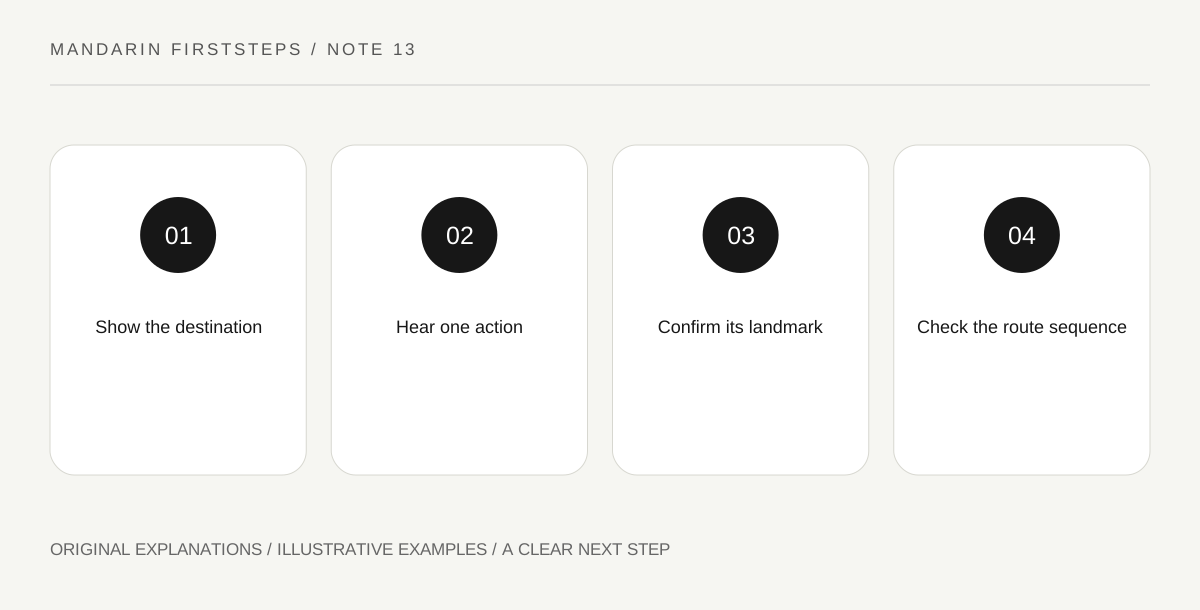
Original explanatory diagram. Read the full method and limitations below.
Name a destination that can be recognized
Qǐngwèn, dìtiězhàn zài nǎr, 请问,地铁站在哪儿, asks excuse me, where is the metro station? Qǐngwèn opens a question politely. The destination must still be specific enough: a city may have many stations. Show the written name or map pin if the place is not a generic nearby landmark.
Learn the characters for the place as well as the pronunciation. A screenshot can help when your spoken name is unclear, but make sure the pin identifies the intended entrance or building rather than an entire district. The language task begins with a destination both people can recognize.
Learn movement as small action chunks
Wǎng zuǒ zǒu, 往左走, means go left; wǎng yòu zǒu means go right; yìzhí zǒu, 一直走, means go straight ahead. Zuǒ and yòu are easy to confuse under pressure. Connect them to a physical turn during practice instead of learning only an English translation pair.
Make a simple paper map with one junction. A partner gives one instruction, and you move a token. Add a second instruction only when the first is reliable. A realistic spoken route may use different wording, so learn these as a base and practise clarification when an unfamiliar phrase appears.
Check the landmark and the sequence
An instruction such as turn left after the café depends on recognizing both the café and the word after. A learner who hears left but misses the reference point may turn too soon. Ask the speaker to point on a map or break the route into shorter pieces when needed.
Repeat the first instruction and point to the relevant junction. Then ask about the next landmark. This confirms more than nodding does. A nearby place is not always reachable by the apparent straight line on a map; entrances, crossings and access restrictions can change the practical route.
Use confirmation without outsourcing judgment
Distant destinations, unfamiliar surroundings or rapidly changing routes may require a map service, signs or transport staff. A language exchange cannot establish that a route is safe or currently accessible. Follow posted instructions and use ordinary situational judgment while treating the spoken directions as one source of information.
For the final exercise, give the listener an incomplete map and the speaker a complete one. The listener draws the route while asking for repeats. Compare the maps before moving a token through them. The goal is a correctly understood sequence, not a fast monologue full of direction words.
Illustrative two-junction route
A learner asks for the library and shows its written name. The partner points to the practice map and says to go straight, then right. The learner repeats Yìzhí zǒu, then points at the second junction and says Yòu? The partner corrects the junction before the learner traces the route. The correction reveals a sequence mistake, although the direction word itself was understood.
Practical checks
Optional checkboxes save only in this browser.
Questions that come up
Should I memorize a long directions dialogue?
A short model helps, but practise changing the landmark and turn order. Real answers will differ from a script. The ability to ask for a repeat and check a map matters more than reproducing one long route.
What if I only understand one instruction?
Confirm that part and ask the speaker to slow down, repeat or point. Do not pretend to understand the rest. Use written directions or an appropriate navigation tool if the spoken exchange remains unclear.
References and scope
These sources support the factual background. Examples and exercises are original illustrative teaching material. References do not imply endorsement.
- Open University: Asking questions with what and where — Question words in their corresponding statement positions.
- Open University: Location, location, location — Using location phrases in simple descriptions of activities.
- Open University: Beginners’ Chinese audio collection — Beginner conversation topics including directions, buying things, restaurant orders and invitations.